Silent Bottleneck: The Case for Auditing the Network Switches Your Business Stopped Thinking About Years Ago
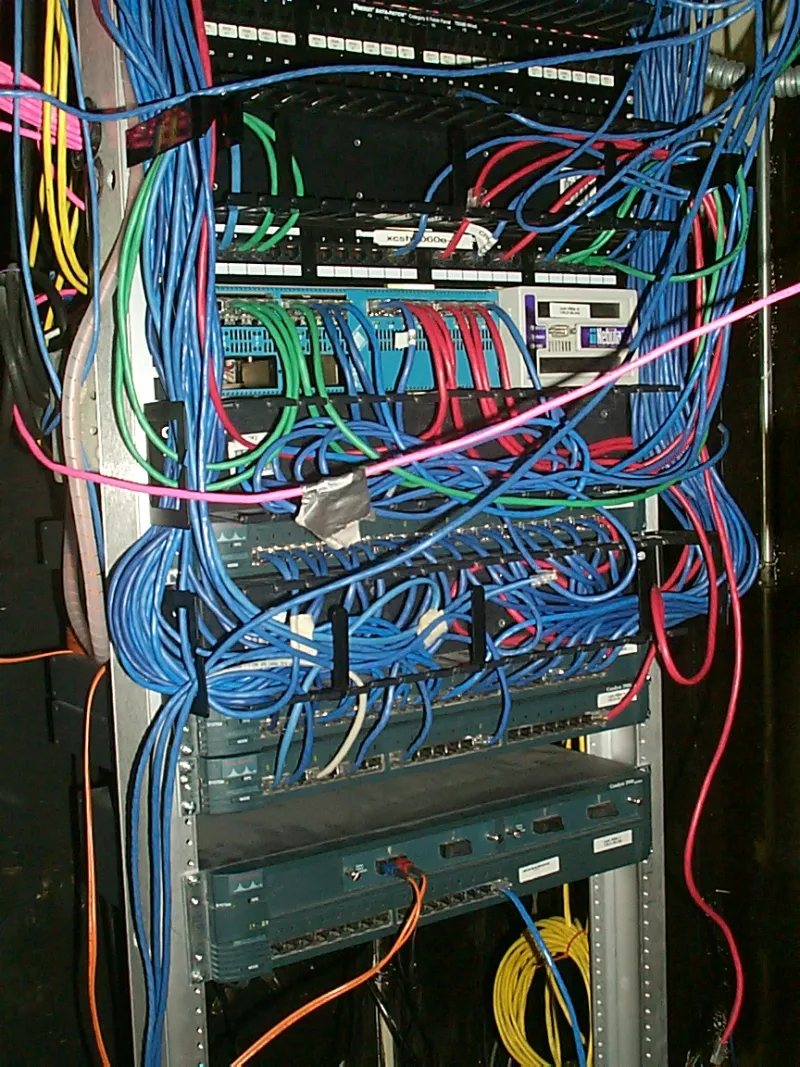
Photo: Jon Parise, CC BY-SA 2.0, via Wikimedia Commons
There is a particular category of IT infrastructure that occupies a curious position in most mid-market organizations: essential enough that its failure would be immediately catastrophic, yet overlooked enough that nobody can say with confidence when it was last formally evaluated. Network switches fall squarely into that category. Unlike laptops, which employees complain about, or software subscriptions, which appear on quarterly budget reviews, the managed switch sitting in a wiring closet simply keeps working — until it doesn't, or until its limitations quietly become someone else's problem.
For a significant portion of US businesses in the 100-to-1,000-employee range, the core switching infrastructure currently in production was purchased somewhere between 2012 and 2017. That equipment predates widespread 802.11ac Wi-Fi deployments, the normalization of 4K video conferencing, the explosion of IoT endpoints on corporate networks, and in many cases, the security frameworks that now govern how network access should be segmented and controlled. The hardware still passes packets. But the question of whether it does so efficiently, securely, and at a cost that makes sense in 2025 is one that remarkably few IT teams have formally answered.
Why Network Infrastructure Gets Deprioritized
The pattern is consistent across industries. When IT budget cycles begin, endpoint refreshes generate the most visible advocacy. Employees report slow laptops. Managers escalate complaints. Help desk tickets create a paper trail that justifies hardware spend. Network infrastructure, by contrast, generates complaints only when it fails outright — and modern managed switches are engineered to run for years past their useful productive life without triggering the kind of visible disruption that forces a budget conversation.
This reliability, paradoxically, becomes a liability. Because aging switches rarely fail dramatically, organizations never accumulate the incident documentation that would otherwise justify a refresh proposal. The result is a procurement gap: endpoint hardware turns over on three-to-five-year cycles, but switching infrastructure sits on indefinite extension until something forces the issue.
There is also a knowledge gap at play. In many mid-market IT departments, the engineers who originally specified and deployed the switching environment have moved on. Current staff inherited the infrastructure, learned its topology well enough to keep it running, and understandably have little appetite for advocating a significant capital expenditure on equipment that is not visibly broken.
The Hidden Costs Nobody Is Measuring
The business case for a network switch audit does not rest on catastrophic failure scenarios. It rests on the cumulative cost of operating infrastructure that was designed for a different network environment than the one that exists today.
Power consumption is the most straightforward example. Switching hardware manufactured before 2016 predates significant advances in energy-efficient Ethernet standards and power supply design. A 48-port managed switch from 2013 may consume 30 to 50 percent more power per port than a comparable current-generation device. For organizations running dozens of switches across multiple locations, that differential compounds into a measurable line item on the utility bill — one that rarely gets attributed to network infrastructure because facilities costs and IT costs are tracked separately.
Support and patching gaps represent a more serious concern. Most enterprise networking vendors — Cisco, HPE Aruba, Juniper, and their competitors — follow published end-of-life timelines that terminate both software maintenance and security patch availability for older platforms. Equipment running on an unsupported firmware branch is not receiving vulnerability remediation. Given that network switches sit at the intersection of every data flow within an organization, an unpatched switch is not a peripheral risk — it is a central one. Several documented attack campaigns in recent years have specifically targeted network infrastructure firmware as an entry point precisely because organizations are slower to patch switches than servers or endpoints.
Throughput limitations are the subtler productivity story. A 1-gigabit access layer switch was entirely adequate for a workforce whose heaviest network activity was email and file shares. That same switch, now serving employees who are simultaneously on video calls, accessing cloud-hosted applications, syncing large files to SharePoint or Google Drive, and operating multiple authenticated devices, is operating in a fundamentally different traffic environment. Uplink saturation on aging switches is a common but rarely diagnosed contributor to the vague, intermittent slowness that employees report and IT teams struggle to reproduce in testing.
Distinguishing Genuine Need from Vendor-Manufactured Urgency
It would be incomplete to discuss network refresh cycles without acknowledging that the networking vendor ecosystem has a strong financial interest in accelerating procurement decisions. Sales representatives will present end-of-life notices, competitive benchmarks, and total-cost-of-ownership analyses that consistently favor immediate replacement. That material is not fabricated, but it is curated — and mid-market IT leaders deserve an independent framework for evaluating it.
A credible switch infrastructure audit should answer four questions before any refresh proposal reaches a budget committee.
First: What firmware version is currently running, and is it receiving active security updates? This is a binary determination. If the answer is no, the conversation about timeline changes immediately.
Second: What are the actual utilization metrics on uplinks and inter-switch connections? Most managed switches provide SNMP data or built-in traffic monitoring. Sustained uplink utilization above 70 to 80 percent during business hours is a documented performance constraint, not a theoretical one.
Third: Does the current switching infrastructure support the access control and segmentation policies the organization's security posture requires? Older switches may lack the VLAN flexibility, 802.1X authentication support, or dynamic access control list capabilities that modern zero-trust network architectures depend on. If the security team has written policies that the network hardware cannot enforce, that is a substantive gap.
Fourth: What is the realistic failure replacement cost if a core switch fails without a planned procurement process in place? Emergency hardware procurement, expedited shipping, and unplanned downtime carry costs that dwarf the price differential between a planned refresh and a reactive one. Aging infrastructure without a refresh plan is, in effect, a self-insurance position against a known-probability event.
Building the Refresh Case Without Overstating It
Not every organization operating older switching infrastructure needs an immediate full replacement. A phased approach — prioritizing core and distribution layer switches, then access layer, then branch locations — allows organizations to align capital expenditure with actual risk exposure rather than treating the entire environment as uniformly urgent.
What every organization does need, regardless of where it lands on the refresh timeline, is a documented current-state inventory. Surprisingly many mid-market IT teams cannot produce an accurate list of every managed switch in production, its firmware version, its support status, and its physical location. That inventory is the prerequisite for every other conversation — budget, security, and operational continuity alike.
The network switch is not a glamorous procurement category. It will not generate the internal enthusiasm of a laptop refresh or the executive visibility of a cloud migration. But for organizations that have not formally evaluated their switching infrastructure in the past five to seven years, the audit is overdue — and the cost of continuing to defer it is not zero. It is simply being paid in ways that nobody has yet added up.